In my spring 2024 MLS 512 class, I had the opportunity and pleasure of creating artifacts for a class project. I was assigned to the topic of justice. Hell yeah!
Of course, what a wide-ranging topic to explore. I choice SCOTUS – mostly focused on Supreme Court Associate Justice Ruth Bader Ginsburg’s legal career – to highlight how important our votes are for impacting and influencing the highest court of the U.S. and federal law. The President nominates justices, and the Congress holds hearings to confirm these justices. Voting for Congressional members and the President matters, as does voting for local representatives. We CANNOT let our voices be silenced, and we must vote!
Following is my first post on the topic of Justice for the Collaborative Digital Archives Assignment.
I am interpreting the theme of Justice through the lens of Supreme Court Associate Justice Ruth Bader Ginsburg’s legal career. I chose Justice Ginsburg – not only because of her role as a Supreme Court Associate Justice and all the amazing legal work and precedent she established in that capacity – but also, and specifically because of her record of successful arguments in front of the Supreme Court when she was an attorney for the ACLU in the 1970s, and her ability to persuade an all-white male Supreme Court to reconsider the legal rights and abilities of women to execute tasks as capable human beings being equal to men.
Justice Ginsburg worked tirelessly to establish equal rights for women to be on par with men’s rights, generally argued with support from legal precedent and the Equal Protection Clause of the 14th Amendment of the U.S. Constitution.
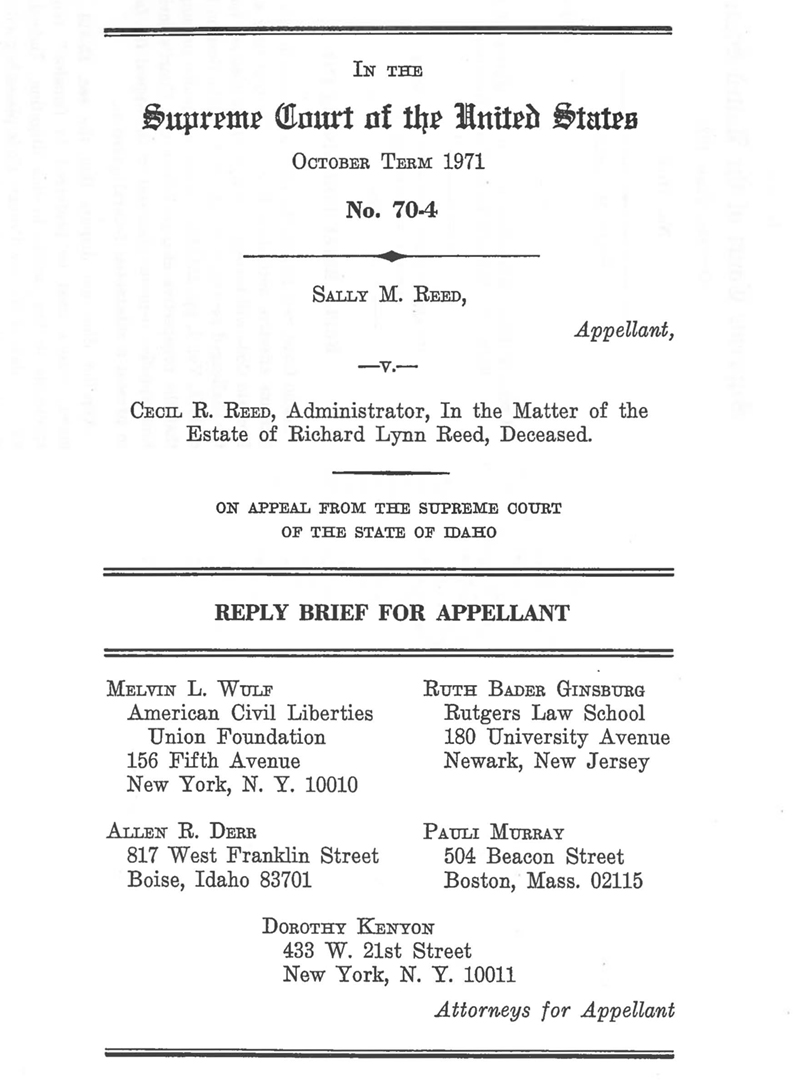 In 1971, Ruth Bader Ginsburg was the first tenured professor of law at Rutgers University. She was also working for the American Civil Liberties Union as a attorney. This particular artifact, the “Reply Brief for the Appellant,” is an eloquent example of Justice Ginsburg’s citing of legal cases and poignant writing.
Ginsburg wrote in this brief (highlighted on page three on this pdf):
“The myth that women are inherently disqualified for full participation in public life as independent persons is no longer acceptable. Yet this Court’s silence has deferred recognition by the law that women are full persons, entitled as men are to due process guarantees and the equal protection of the laws. The time to break the vicious cycle which sex discriminatory laws create is overdue. If a legislature can bar a woman from service as a fiduciary on the basis of once popular, but never proved, assumptions that women are less qualified than men are to perform such services, then the myth becomes insulated from attack, because the law deprives women of the opportunity to prove it false. Cf. Carrington v. Rash, 380 U.S. 89, ~3, 96 (1965).”
I found this artifact through an online search of Justice Ginsburg’s first argument in front of SCOTUS. I love the depth – yet succinct – nature of the argument. I love the font and the powerful words. It is historically significant because her words led to the landmark decision: “404 U.S. 71 (1971), which marked the first time in history that the Court applied the Equal Protection Clause of the Fourteenth Amendment to strike down a law that discriminated against womenLinks to an external site..”
As a women who was raised by a white man/father in the military industrial complex, this artifact appeals to me because I’ve been both roles of dominator and oppressed. At the same time, as a women in this U.S. society, I’ve been subjugated in ways that are often unconsciously biased by the dominant paradigm.
Knowing and seeing how women are still oppressed, it is galvanizing to discover Ginsburg’s first brief to the Supreme Court, which ultimately won.
Here’s the original link to the PDF.
Leave a Reply